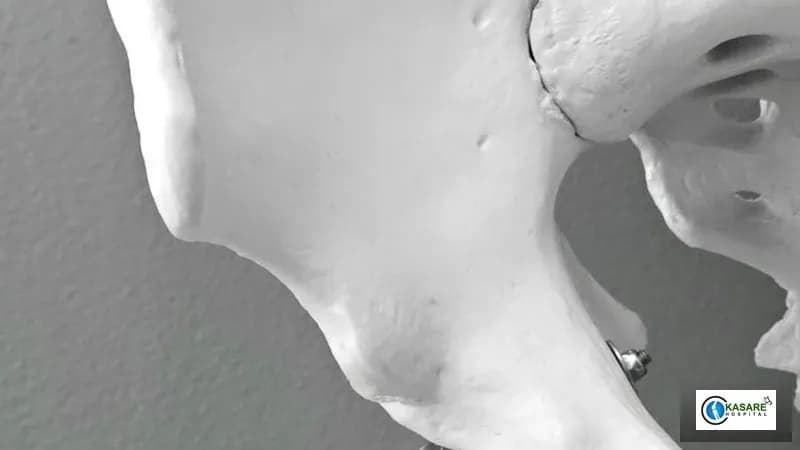
What is total hip replacement surgery?
Total hip replacement surgery in Yavatmal is a procedure in which a damaged hip joint is replaced with an artificial implant, restoring mobility and relieving chronic pain. At Kasare Hospital, Yavatmal, orthopaedic surgeon Dr. Prashant Kasare (MBBS, D Ortho) performs hip replacement procedures in an International Standard Modular Operation Theatre — the first of its kind in Yavatmal and third in Central India. This surgery is most commonly recommended for patients whose hip joint has been severely damaged by osteoarthritis, fracture, or other degenerative conditions, and for whom conservative treatments no longer provide adequate relief.
- The procedure replaces the femoral head (ball) and acetabulum (socket) with prosthetic components.
- It is performed under spinal or general anaesthesia, typically lasting 1.5 to 2.5 hours.
- Most patients begin walking with assistance within 24 hours of surgery.
- The goal is to eliminate hip joint pain and restore functional range of motion.
- Kasare Hospital has served 75,000+ patients across orthopaedic and related specialities since 2014.
Tip: If hip pain is limiting your daily activities — walking, climbing stairs, or rising from a chair — a consultation with an orthopaedic specialist in Yavatmal can determine whether hip replacement is appropriate for you.
Signs and symptoms that may indicate you need hip replacement surgery
Patients who are candidates for hip replacement surgery in Maharashtra typically present with a combination of the following symptoms. If you recognise several of these, it is time to seek a formal orthopaedic assessment.
- Persistent hip or groin pain that does not improve with rest, medication, or physiotherapy
- Stiffness in the hip joint that restricts the ability to move the leg or put on shoes and socks
- Pain that wakes you from sleep or is present even at rest
- A grinding, clicking, or locking sensation in the hip joint
- Visible limping or an altered gait pattern to compensate for pain
- Reduced range of motion — difficulty bending, rotating, or extending the hip
- Swelling or tenderness around the hip joint
- Inability to walk more than short distances without significant discomfort
These symptoms are commonly associated with osteoarthritis, avascular necrosis, rheumatoid arthritis, or post-fracture joint damage — all conditions managed at Kasare Hospital's orthopaedic services department in Yavatmal.
What causes hip joint damage requiring replacement surgery?
Understanding the underlying cause of hip joint deterioration helps determine the most appropriate treatment. The following conditions most frequently lead to the need for total hip replacement:
- Osteoarthritis — the most common cause; cartilage in the hip joint wears away over time, causing bone-on-bone friction and pain
- Rheumatoid arthritis — an autoimmune condition that inflames the joint lining and progressively destroys cartilage and bone
- Post-traumatic arthritis — joint damage following a hip fracture or serious injury, even years after the original trauma
- Avascular necrosis (osteonecrosis) — loss of blood supply to the femoral head causes bone tissue to collapse
- Hip dysplasia — abnormal development of the hip socket from birth or childhood, leading to early joint wear
- Severe hip fractures — particularly in older adults, where fracture management alone is insufficient to restore function
Warning: Delaying treatment for avascular necrosis or severe osteoarthritis can lead to complete joint collapse, making surgery more complex. Seek an orthopaedic assessment promptly if hip pain is worsening.
Who is at higher risk of needing hip replacement surgery?
Certain factors increase the likelihood that a patient will develop hip joint damage severe enough to require replacement. Identifying these risk factors early allows for preventive management and timely referral to an orthopaedic surgeon in Yavatmal.
- Age above 50 — the incidence of osteoarthritis and avascular necrosis rises significantly with age
- Obesity — excess body weight places disproportionate mechanical load on the hip joint, accelerating cartilage wear
- Previous hip injury or fracture — prior trauma predisposes the joint to post-traumatic arthritis
- Family history of arthritis — genetic predisposition to osteoarthritis or rheumatoid arthritis
- Long-term corticosteroid use — associated with avascular necrosis of the femoral head
- Sedentary lifestyle — weakened muscles around the hip reduce joint stability and increase wear
- Occupational or athletic overuse — repetitive high-impact activity over many years
How is hip joint damage diagnosed before surgery?
A thorough diagnostic workup is essential before recommending hip replacement surgery. At Kasare Hospital, Yavatmal, the diagnostic process combines clinical assessment with on-site imaging and laboratory services, enabling rapid, accurate evaluation without the need for external referrals.
Typical diagnostic steps include:
- Clinical examination — assessment of gait, range of motion, pain on palpation, and leg-length discrepancy
- X-ray (plain radiograph) — the primary imaging tool; reveals joint space narrowing, bone spurs, and structural deformity
- MRI scan — used when avascular necrosis, soft-tissue pathology, or early-stage disease is suspected
- CT scan — provides detailed bone architecture for pre-operative planning in complex cases
- Blood tests — inflammatory markers (ESR, CRP) and rheumatoid factor to rule out inflammatory arthritis
- Pre-operative assessment — cardiac, respiratory, and anaesthetic fitness evaluation before surgery
Kasare Hospital's in-house pharmacy and diagnostics unit provides X-rays, lab tests, and pre-operative assessments on-site, reducing delays between diagnosis and surgical planning.
What are the treatment options for severe hip joint pain?
Treatment for hip joint damage is staged according to severity. Total hip replacement is typically considered when non-surgical options have been exhausted. The table below compares the main treatment pathways available for patients seeking hip joint pain treatment in Yavatmal.
| Treatment Option | Best For | Recovery Time | Limitations |
|---|
| Physiotherapy & Exercise | Mild to moderate arthritis | Ongoing | Does not reverse structural damage |
| Medications (NSAIDs, DMARDs) | Pain and inflammation management | Ongoing | Long-term use carries side effects; not curative |
| Intra-articular Injections | Moderate arthritis, short-term relief | Days to weeks | Temporary; repeated injections not advised long-term |
| Arthroscopy | Labral tears, loose bodies, early damage | 4–8 weeks | Not effective for advanced arthritis |
| Total Hip Replacement Surgery | Severe arthritis, fracture, avascular necrosis | 6–12 weeks to full activity | Requires surgical fitness; implant has a lifespan |
For patients requiring joint replacement surgery in Yavatmal, Kasare Hospital performs procedures in its International Standard Modular Operation Theatre, adhering to NABH-standard protocols for surgical safety and infection control.
When should you consult an orthopaedic surgeon about hip replacement?
Do not wait until hip pain becomes completely debilitating. Consult an orthopaedic surgeon in Yavatmal if you experience any of the following specific thresholds:
- Hip or groin pain that persists for more than 3 months despite rest and over-the-counter pain relief
- Pain that limits walking to less than 30 minutes before requiring rest
- Inability to perform basic daily tasks — dressing, bathing, or climbing stairs — due to hip stiffness or pain
- Night pain that disrupts sleep on more than 3 nights per week
- X-ray or MRI findings confirming severe joint space narrowing or bone-on-bone contact
- A hip fracture in an older adult where fracture fixation alone is unlikely to restore function
- Progressive worsening of symptoms despite a structured physiotherapy programme of at least 6 weeks
Early consultation allows for a staged treatment plan — beginning with conservative measures and escalating to hip replacement surgery only when clinically indicated. Use the booking form on this page or contact Kasare Hospital directly to arrange an assessment.
How Kasare Hospital in Yavatmal supports patients through hip replacement
Kasare Hospital has been providing orthopaedic care in Yavatmal, Maharashtra since 2014, with a team led by Dr. Prashant Kasare (MBBS, D Ortho). The hospital's infrastructure and patient support systems are designed to manage the full continuum of care — from initial diagnosis through surgery and hip replacement recovery.
- International Standard Modular Operation Theatre — the first in Yavatmal and third in Central India, ensuring sterile, high-standard surgical conditions for every joint replacement surgery
- Specialist-led care — Dr. Prashant Kasare (MBBS, D Ortho) leads all orthopaedic and surgical procedures, supported by a multidisciplinary team
- In-house diagnostics — X-rays, lab tests, and pre-operative assessments available on-site, reducing wait times before hip surgery in Yavatmal
- Post-operative rehabilitation — structured sports injury and orthopaedic rehabilitation programmes to support recovery and restore function
- Cashless insurance facility — authorised mediclaim providers accepted, with insurance claim assistance and transparent billing; EMI options available
- 75,000+ patients served and 7,865+ admissions and surgeries completed, reflecting consistent clinical experience across orthopaedic procedures
Book a consultation at Kasare Hospital
Use the booking form on this page, or reach out directly:
Call: +91 9823112882
WhatsApp: 9823112882