The first few minutes after a fracture matter — correct first aid can protect the limb, limit pain, and set up a smoother recovery once you reach definitive care in Yavatmal.
By Dr. Prashant Kasare, Kasare Hospital
A broken bone is frightening, and road accidents, agricultural falls, and sports injuries are among the most common reasons families bring loved ones to our emergency desk. As someone who has spent over 15 years managing fractures, dislocations, and complex trauma, I can tell you that what happens in the first 20–30 minutes — before a patient ever reaches a hospital bed — genuinely influences how smoothly the rest of treatment goes. Mishandling a fractured limb at the scene can convert a simple fracture into a more complicated injury, damage nearby nerves or blood vessels, or make later surgical fixation harder. This guide walks you through what to do, what to avoid, and when to rush straight to an orthopaedic emergency team in Yavatmal rather than wait it out at home.
A fracture is simply a break or crack in a bone, ranging from a thin hairline crack to a bone shattered into several pieces. Fractures are generally grouped as closed (the skin stays intact) or open/compound (a bone fragment pierces the skin, exposing it to infection risk). They can also be classified by pattern — transverse, oblique, spiral, comminuted, or greenstick (common in children, where the bone bends and partially cracks rather than breaking fully). The treatment approach, recovery timeline, and risk of complications differ significantly between these types, which is why an accurate diagnosis always comes before deciding on treatment.
| Fracture Type | What It Looks Like | Typical Cause |
|---|---|---|
| Hairline / Stress | Thin crack, minimal deformity | Repetitive stress, overuse |
| Closed (Simple) | Bone broken, skin intact | Falls, direct blows |
| Open (Compound) | Bone pierces through skin | High-impact road accidents |
| Comminuted | Bone shattered into 3+ fragments | High-speed trauma, crush injury |
| Greenstick | Partial crack, bone bends | Falls in children |
Being a semi-urban district with heavy highway traffic and a largely agrarian population, Yavatmal sees a distinct mix of fracture causes: two-wheeler and highway road traffic accidents, falls from height on farms or during harvest work, sports and playground injuries in younger patients, and low-impact falls leading to hip or wrist fractures in older adults with weaker bones. Each of these mechanisms tends to produce a different fracture pattern, which is part of why our fracture management procedures are tailored to the specific bone, age, and injury mechanism rather than treated with a one-size-fits-all protocol.
Not every painful injury is a fracture, but the following signs should raise suspicion and prompt you to treat the limb carefully until it can be checked:
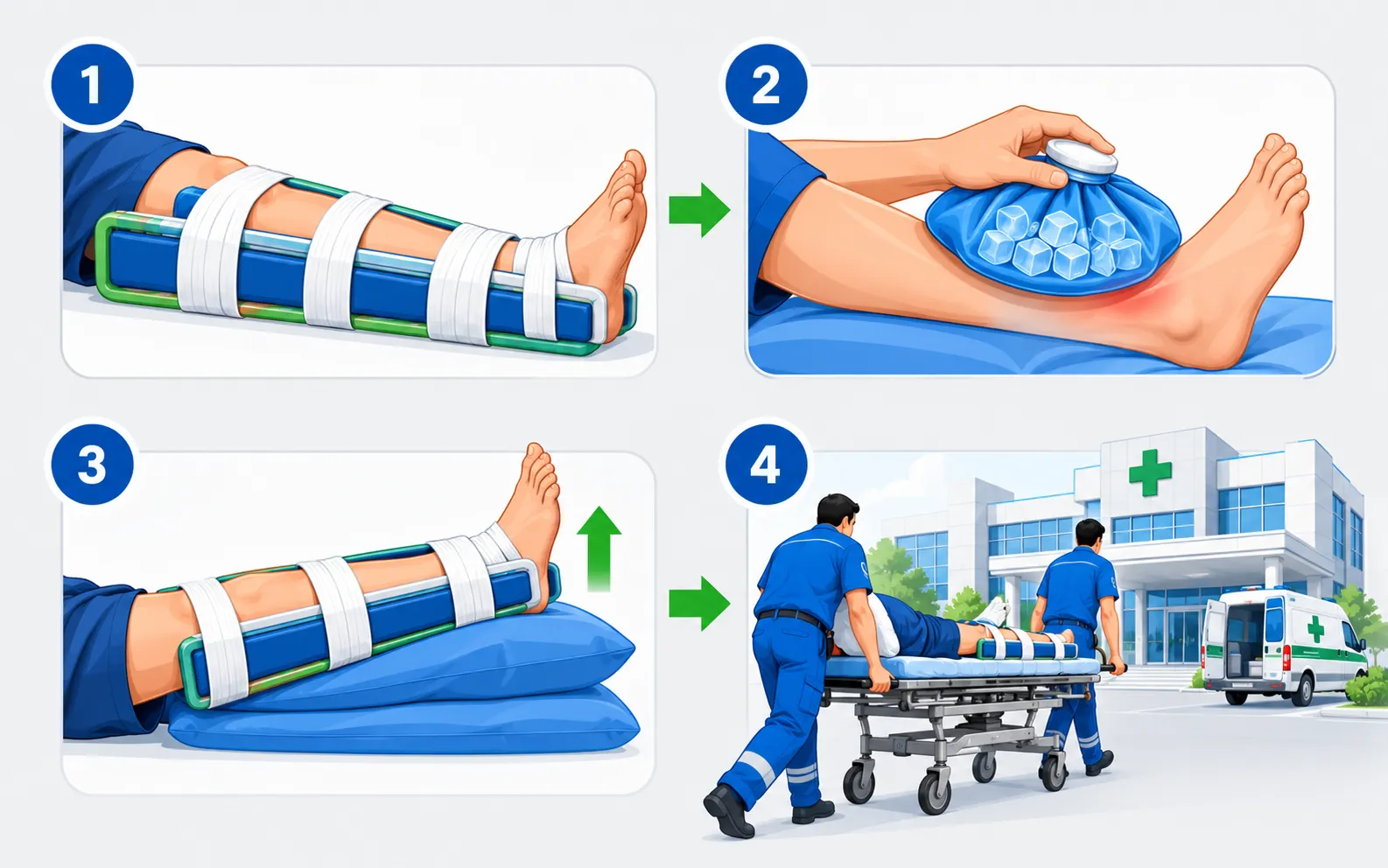
If you suspect a fracture, follow these steps before the patient reaches the hospital:
Tip: If you don't have a rigid splint, bandaging an injured arm to the chest or an injured leg to the opposite leg can act as an effective temporary support until professional help is available.
Warning: Never try to "straighten" a visibly deformed limb or push a protruding bone back under the skin — this can worsen nerve or vessel damage. Do not give the patient food or water if surgery may be needed soon, do not let them walk on a suspected leg or foot fracture, and do not remove a helmet after a road accident unless breathing is obstructed, as this can worsen an undiagnosed neck injury. Seek emergency medical help immediately in all these situations.
Most fractures need prompt medical attention, but some signs mean you should head straight to an emergency department rather than a routine clinic visit.
Warning: Seek emergency care immediately if there is heavy bleeding, an open wound with visible bone, a limb that looks cold, pale, or numb, severe deformity, suspected spine or pelvis injury, or if the patient is drowsy, confused, or in shock after an accident. Every minute counts in these situations.
Once you reach the hospital, accurate imaging is the backbone of safe fracture care. At Kasare Hospital, our on-site digital X-ray and advanced diagnostic imaging support faster evaluation of the fracture pattern, displacement, and joint involvement, so treatment decisions aren't delayed waiting on outside labs. For fractures requiring surgical fixation, a C-arm image intensifier is used during the procedure itself, allowing real-time X-ray guidance so implants and screws are positioned with precision — this intraoperative imaging is a key reason surgical fixation can be both accurate and efficient.
Not every fracture needs surgery. Treatment is decided based on the bone involved, the fracture pattern, displacement, the patient's age, and overall health.
Surgical fractures at our hospital are managed in our International Standard Modular Operation Theatre — the first of its kind in Yavatmal and third in Central India — under Dr. Prashant Kasare, who trained in accident and trauma fellowship under Dr. D. D. Tanna in Mumbai and brings over 15 years of focused orthopaedic and trauma experience, including clinical exposure at institutions such as AIIMS, RML Hospital, and Lilavati Hospital. Every treatment decision follows our quality care standards, built around NABH-standard protocols, with honest, transparent counselling about what each fracture genuinely needs.
Bone healing itself typically takes anywhere from 4 to 12 weeks depending on the bone, the patient's age, and the fixation method, but full functional recovery often depends just as much on what happens after the cast comes off or the implant is placed. Stiffness, muscle weakness, and reduced joint range of motion are common if rehabilitation is skipped. That's why physiotherapy and rehabilitation support is built into our fracture care pathway at Kasare Hospital — so patients move from surgery or casting into guided movement and strengthening without a gap in continuity of care. Regular follow-up X-rays help confirm the bone is healing in correct alignment before activity levels are increased.
Fractures are frightening, but correct first aid in those first critical minutes — stabilising the limb, avoiding unnecessary movement, and getting to definitive care quickly — genuinely changes outcomes. If you or a family member has a suspected fracture, please don't wait to see if it "settles down" on its own. Reach out to our orthopaedic emergency care team in Yavatmal for prompt evaluation and treatment.