Persistent back or leg pain can quietly take over daily life — here's how to recognise the warning signs and when it's time to consult a spine specialist in Yavatmal.
By Dr. Prashant Kasare, Kasare Hospital
Back pain is one of the most common reasons patients walk into our OPD at Kasare Hospital in Yavatmal. For some, it's a dull, nagging ache after a long day of farming, driving, or sitting at a desk. For others, it's a sharp, shooting pain that travels down one leg, making it difficult to stand, sit, or sleep. These two presentations often point to very different underlying problems — mechanical back strain versus nerve compression from a slipped (herniated) disc — and knowing the difference matters for getting the right treatment early.
As a consultant orthopaedic surgeon with over 15 years of experience managing spinal and musculoskeletal conditions, I see patients across all age groups in Yavatmal — from young adults with sports- or desk-job-related strain to older patients with age-related disc degeneration. This guide walks through what actually causes back pain, slip disc, and sciatica, how we diagnose them, the treatment options available, and — most importantly — the red-flag symptoms that mean you shouldn't wait to see a spine specialist.
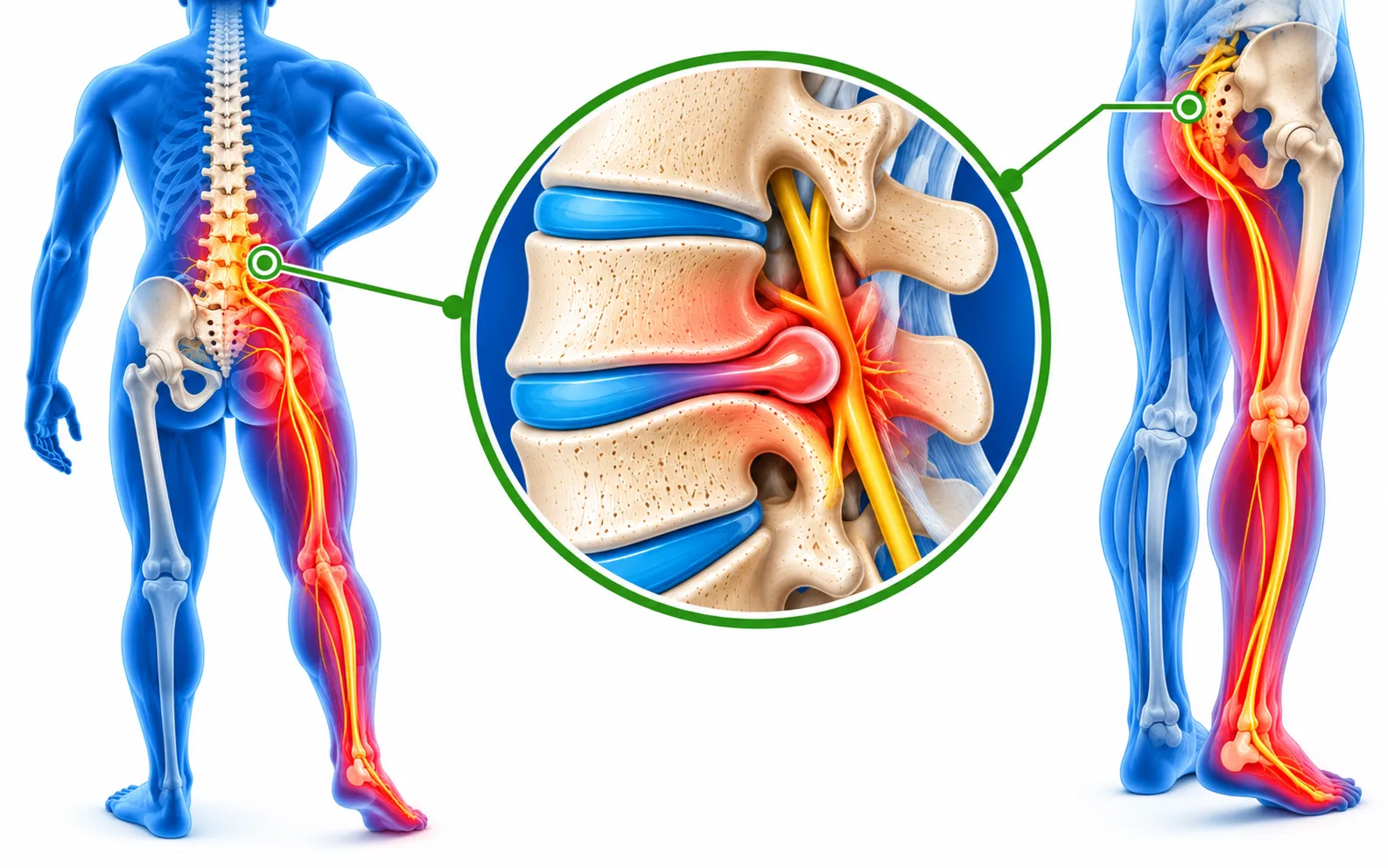
The spine is a complex structure of vertebrae, discs, nerves, and muscles, and pain can originate from any of these. Common causes we encounter include:
Muscle or ligament strain: from heavy lifting, sudden awkward movement, or prolonged poor posture.
Degenerative disc disease: natural wear-and-tear of spinal discs with age, reducing their cushioning ability.
Herniated or slip disc: the soft inner material of a disc pushes through its outer layer and presses on nearby nerve roots.
Spinal stenosis: narrowing of the spinal canal that compresses nerves, common in older adults.
Sedentary lifestyle and obesity: prolonged sitting and excess body weight place additional load on the lower spine.
Trauma or accidents: fractures or ligament injuries from falls or road traffic accidents.
Sciatica itself is not a diagnosis but a symptom — it refers to pain radiating along the sciatic nerve, usually from the lower back down through the buttock and leg. It most often results from a slip disc or spinal stenosis pressing on the nerve roots that form the sciatic nerve.
Tip: Avoid prolonged bed rest for ordinary back pain — gentle movement and activity, guided by a specialist, usually helps recovery more than complete immobility.
Not every backache needs surgery, and not every leg pain is sciatica. The table below highlights how these conditions typically differ in presentation, which helps guide the initial conversation with your doctor.
| Condition | Typical Symptoms | Common Triggers |
|---|---|---|
| Mechanical back pain | Localised dull or stiff ache, worsens with activity, improves with rest | Heavy lifting, poor posture, prolonged sitting |
| Slip disc (herniated disc) | Sharp back pain, often with numbness or tingling radiating to the leg | Sudden twisting, repetitive strain, age-related disc wear |
| Sciatica | Shooting pain from lower back through buttock and leg, weakness, pins-and-needles | Slip disc, spinal stenosis, nerve root compression |
A careful clinical examination is the starting point — assessing posture, range of motion, reflexes, and nerve function to localise the problem. At Kasare Hospital, this is supported by on-site digital X-ray and a C-arm image intensifier, which allow faster, more accurate visualisation of the spine without sending patients elsewhere for basic imaging. Where more detailed soft-tissue evaluation is needed, such as confirming a suspected slip disc, we guide patients toward appropriate advanced imaging and pre-operative assessments before planning spine surgery or conservative management.
This diagnostic pathway is part of what our orthopaedic specialists at Kasare Hospital rely on to tailor a treatment plan to each patient rather than applying a one-size-fits-all approach.
Most cases of back pain and even many slip disc cases respond well to conservative management first:
Activity modification and short-term rest, followed by guided movement
Pain and anti-inflammatory medication under medical supervision
Physiotherapy and core-strengthening exercises to support the spine
Posture correction, ergonomic adjustments, and weight management
When conservative treatment doesn't relieve symptoms, or when there is significant nerve compression causing progressive weakness, surgical intervention — such as discectomy or decompression surgery — may be recommended. Surgeries at Kasare Hospital are performed in our International Standard Modular Operation Theatre, the first of its kind in Yavatmal and third in Central India, supported by orthopaedic power tools and C-arm guidance for precise, image-guided correction. This infrastructure, combined with NABH-standard protocols, allows us to manage complex orthopaedic and spinal cases locally, without patients needing to travel to larger cities.
Most back pain improves with rest and basic care within a few weeks. However, certain symptoms should never be ignored.
Warning: Seek emergency care immediately if you experience loss of bladder or bowel control, numbness in the groin or inner thighs (saddle anesthesia), rapidly progressing leg weakness, or back pain following a significant fall or accident — these can indicate cauda equina syndrome or a spinal fracture, both of which require urgent evaluation.
You should also book a consultation — rather than waiting it out — if pain persists beyond 2–3 weeks, radiates below the knee, is accompanied by fever or unexplained weight loss, or interferes with sleep and daily function. Early evaluation of a slip disc or sciatica usually means more conservative, less invasive treatment options remain on the table.
Kasare Hospital has been serving Yavatmal since 2014 with a mission to deliver world-class orthopaedic and trauma care at an affordable cost. A few reasons patients trust us with their spine and back pain concerns:
15+ years of clinical experience in orthopaedics, trauma, and spinal conditions under Dr. Prashant Kasare, with fellowship training in joint replacement, hand, and foot & ankle surgery and clinical exposure at AIIMS and Lilavati Hospital
Our International Standard Modular Operation Theatre — the first in Yavatmal and third in Central India — for precision spine and orthopaedic surgery
On-site digital X-ray, C-arm image intensifier, and integrated physiotherapy for continuity from diagnosis through rehabilitation
NABH-standard protocols and a track record of over 7,865 admissions & surgeries and 75,000+ patients served
You can learn more about our quality care standards, which guide how we manage everything from routine fracture management to complex spine surgery.
Whether you're recovering from conservative treatment or spine surgery, rehabilitation is a critical part of getting back to normal life. Physiotherapy helps rebuild core and back muscle strength, improves flexibility, and reduces the risk of recurrence. We also counsel patients on posture, safe lifting techniques, regular low-impact exercise, and maintaining a healthy body weight — all of which reduce long-term strain on the spine. Related musculoskeletal conditions like osteoarthritis and spinal deformities such as scoliosis are managed with the same patient-centred, rehabilitation-focused approach.
If back pain, a suspected slip disc, or sciatica symptoms are affecting your daily life, don't wait for them to worsen. Contact Kasare Hospital in Yavatmal to schedule a consultation and get a clear, personalised diagnosis and treatment plan for your spine health.